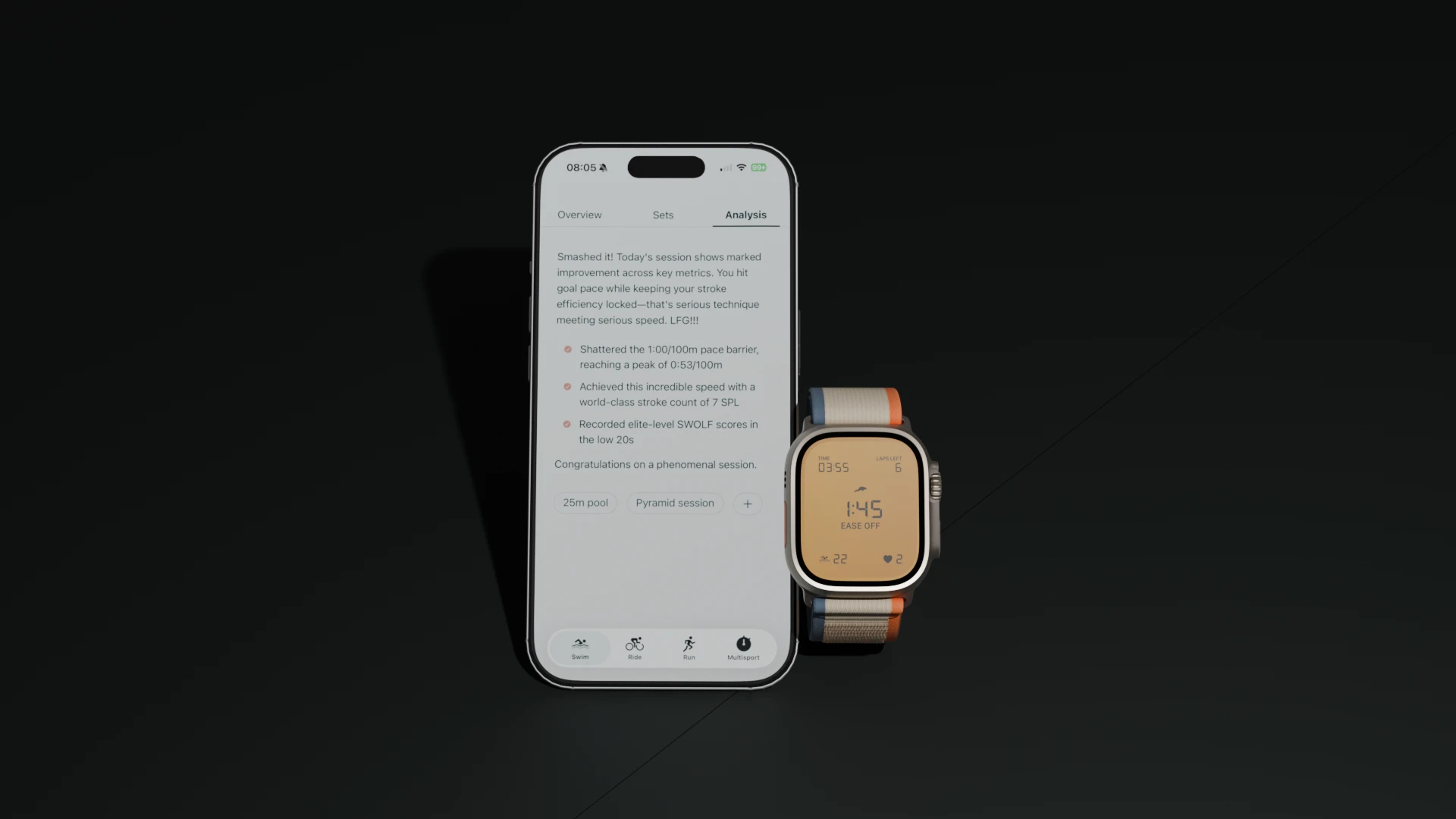
Coaching that speaks human, not numbers
Aspiring triathletes need feedback that compares them to themselves ('How are you pacing this segment compared to last time?'), not just raw metrics.
The coaching covers preparation, real-time guidance during training and post-session analysis. It works across running, cycling, swimming, strength and conditioning, with particular attention to recovery.
Technical work addressed three constraints: custom underwater stroke detection (Apple's SDK could not differentiate race starts from turn transitions), offline audio coaching for swim-specific headphones and a privacy-first architecture where users control their health data.
Solving for SDK gaps and offline training
Building in Swift for iOS and watchOS revealed SDK constraints immediately. Underwater stroke detection required custom algorithms to predict swimming phases and distinguish between race starts and turn transitions—functionality not available natively.
The 'coach in the moment' experience relied on offline audio synthesis. To support devices like the Shokz OpenSwim Pro headphones, personalised coaching audio is pre-generated, ensuring contextual guidance works underwater or without connectivity.
Technical stack and integration:
- Swift for native iOS and WatchOS development
- Claude and Gemini APIs for analysis and coaching generation
- iCloud for cross-platform data storage and sync
- Custom algorithms for underwater activity detection
- Offline audio synthesis for uninterrupted coaching delivery
- Privacy-first architecture: User-controlled data, not for mining or sale
Every technical decision served a specific training need whilst protecting sensitive health data.
Context over raw metrics
Instead of overwhelming athletes with raw numbers, performance translates into conversational insights. A 'ghost mode' allows athletes to train against their own previous performances in real-time. This addresses the core user need: measuring progress against themselves, not arbitrary benchmarks.
An insight like 'You maintained consistent pacing better than your last three sessions' carries more training value than a simple list of split times.
Closed beta testing insights:
- Comparative language is far more motivating than absolute metrics
- Real-time audio feedback is crucial when visual attention is impossible (swimming, for instance)
- Post-workout analysis is most valuable when it identifies multi-session patterns, not just one-off results
- Recovery guidance (or lack of it) was a critical factor in training adherence and injury prevention
Communication preferences adapt whilst keeping number-heavy data available on-demand for those who want to dive deeper.
Privacy-first architecture: Building trust
Sensitive health and performance data requires an ethical, privacy-first architecture. This was a non-negotiable principle: workout data belongs to the user, not the app, and is never mined or sold.
This principle drove technical decisions at every level:
- iCloud storage: Data is stored in the user's personal iCloud, under their control
- Processing boundaries: API requests respect data boundaries and limit exposure
- Full transparency: The app is clear about how and why coaching insights are generated
Trust is the foundation of any coaching relationship, whether human or software. This is designed as a supportive, private partner that respects both the user's ambitions and their data.